

 What is Crest Factor?
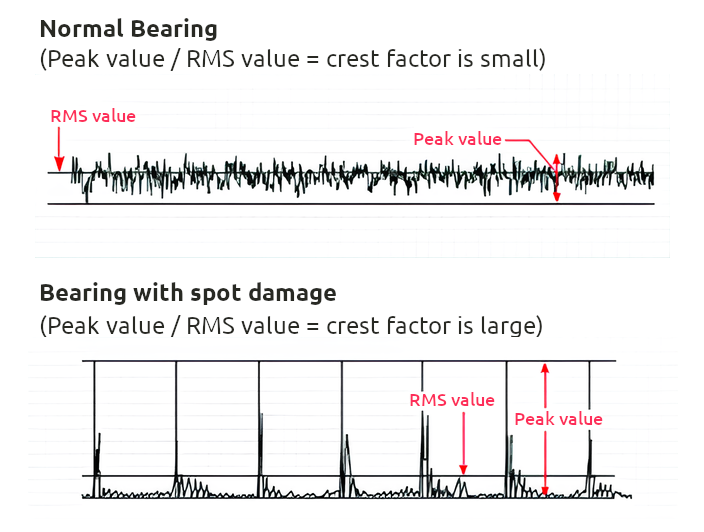
The crest factor is a measure of the sharpness or impulsiveness of a vibration signal. Simply put, it is the ratio of peak acceleration to RMS (root mean square) acceleration, making it a dimensionless value. It indicates how "peaky" a signal is. For example, a smooth signal like a square wave may have a crest factor of 1, whereas a signal with sudden, sharp spikes can have a very high crest factor.
Crest factor can serve as an important indicator for detecting mechanical faults, such as bearing failures. In the early stages of bearing damage, the inner race, outer race, rolling elements, or cage may generate periodic impulse signals, causing the crest factor to increase. However, as the damage worsens, the RMS value (denominator) also rises, leading to a decrease in the crest factor. Due to this limitation, the crest factor should not be used alone for condition monitoring and should be supplemented with other parameters, such as true peak value, for more accurate diagnostics.
A high crest factor may indicate the following mechanical issues:
- Bearing Defects: Worn or damaged bearings produce high-frequency impulses, increasing the peak factor.
- Gear Mesh Problems: Faulty gear engagement can cause high-frequency vibration, resulting in an elevated peak factor.
- Misalignment: Mechanical misalignment may lead to high-frequency vibration and a higher peak factor.
- Mechanical Looseness: Loose components can generate excessive vibration and sudden impact signals, raising the peak factor.
In conclusion, while the crest factor is a valuable parameter in vibration analysis, it should be evaluated alongside other signal characteristics for more reliable fault diagnosis.
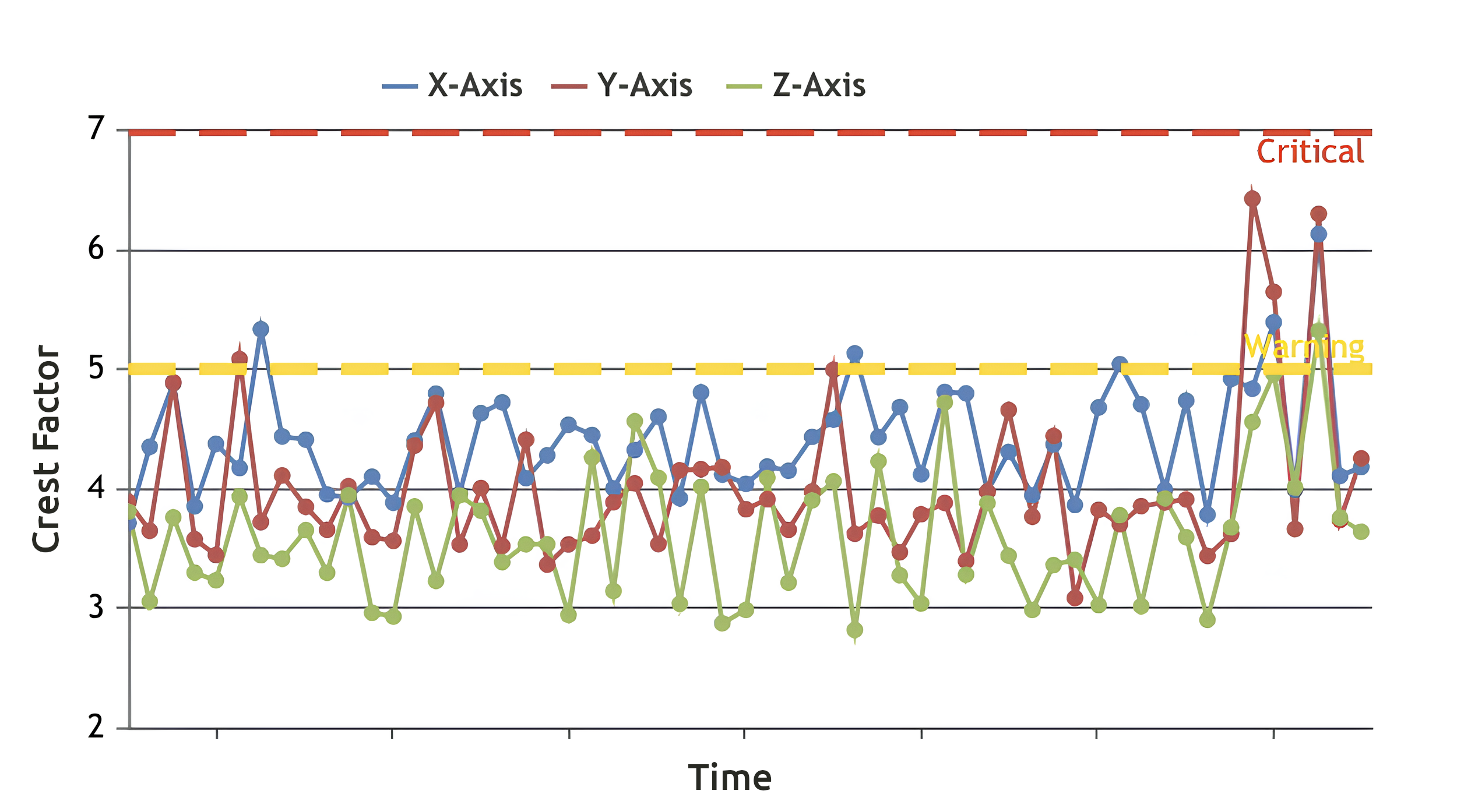
The general range for the crest factor is between 3 and 5, which applies to typical ball bearing electric motors under stable and properly installed conditions. A warning level between 5 and 7 is acceptable, but values of 7 or higher are considered an alarm if they are sustained.